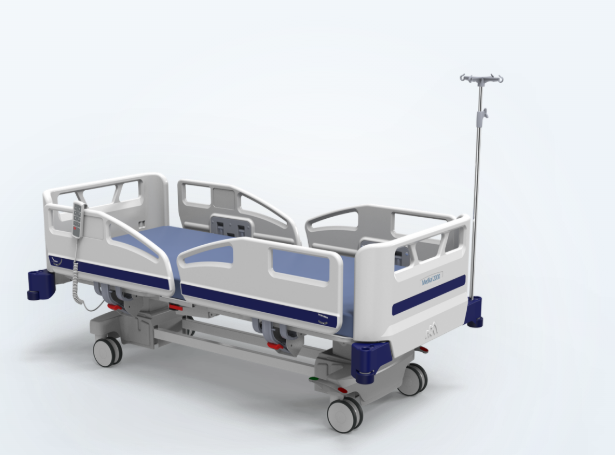
Hospital beds are essential equipment in healthcare facilities for patient comfort, working conditions for healthcare professionals, and the efficiency of care processes. Therefore, hospital bed selection should not be based solely on price or appearance.
The purpose of use, mobility, ergonomics, safety features, ease of maintenance, and technical specifications of beds to be used in hospital rooms, intensive care units, emergency rooms, and various clinical settings should be evaluated together.
So, what should be considered when choosing a hospital bed? Here are the key criteria for selecting a patient bed for healthcare facilities:
1. The Purpose of the Hospital Bed Must Be Determined
It is not necessary to use a bed with the same features for every patient. The patient's condition and the clinic where the bed will be used should be decisive in product selection.
The needs of an electromechanical patient bed used in standard ward rooms differ from those of an intensive care bed used in an intensive care unit.
For example;
For standard patient rooms, electric or mechanical patient beds,
Intensive care beds with advanced positioning features for intensive care units,
Pediatric patient beds for child patients,
Home care patient beds for home care needs,
Maternity beds for maternity and obstetrics clinics
can be preferred.
Therefore, before purchasing a hospital bed, it should be determined in which clinic and for which patient group the bed will be used.
2. Electric or Mechanical Patient Bed?
One of the most important issues in choosing a hospital bed is the bed's movement system.
Mechanical patient beds can meet basic positioning needs thanks to simpler mechanical systems. They can offer an economical and practical solution, especially in certain clinical applications.
Electric patient beds, on the other hand, allow for easier adjustment of different parts of the bed thanks to motorized movement mechanisms.
Depending on the model, electric patient beds have:
Features such as backrest adjustment,
knee/leg adjustment,
height adjustment,
Trendelenburg and reverse Trendelenburg positions,
electric positioning,
remote control
may be available.
Electric patient beds can provide significant advantages, especially in clinics where the patient's position needs to be changed frequently.
3. Patient Safety Should Be a Priority
A hospital bed should not only be mobile. Patient safety should also be considered in bed design.
The structure of the side rails, locking mechanisms, wheel brakes, the stability of the bed, and the safe use of moving parts are the main elements that need to be evaluated.
Safety features are of even greater importance, especially for elderly patients, those with limited mobility, or those under constant supervision.
Therefore, when purchasing a hospital bed, in addition to the technical specifications of the product, its suitability for the relevant usage scenarios should also be evaluated.
4. Bed Positioning Features Should Be Examined
Modern medical patient beds may have different positioning options.
Adjustable back and knee areas, adjustable bed height, and the use of positions such as Trendelenburg in suitable models; It can support patient care processes.
When evaluating positioning features, the clinic and patient profile where the bed will be used should be considered.
For example, the positioning needs of a bed used in intensive care units may not be the same as those of a bed used in a standard ward.
5. Bed Dimensions and Patient Capacity Should Be Checked
Technical dimensions are just as important as mechanical features when selecting a hospital bed.
The bed's:
Total width,
Total length,
Bed platform dimensions,
Minimum and maximum height,
Safe working load,
Dimensions of the mattress that can be used,
should be checked.
In addition, the bed must be compatible with the dimensions of doors, elevators, and corridors in hospital rooms.
Especially if a large number of beds are planned to be purchased in hospital projects, it is important to compare the product dimensions with the project specifications beforehand.
6. Wheel and Brake System Should Be Evaluated
The wheel system is an important component for the safe and controlled movement of the patient bed within the hospital.
Features such as wheel diameter, mobility, and central or independent braking systems can affect the ease of use of the product.
Especially when a patient needs to be transferred to another area, the ease of moving the bed supports the workflow of healthcare personnel.
7. Ease of Cleaning and Hygiene Should Be Considered
In hospital environments, ease of cleaning and maintenance of equipment is an important criterion.
Cleaning processes should be considered when evaluating the surfaces, moving parts, bed platform, and other components of the patient bed.
Easy to clean and properly maintained equipment is crucial.
 Why Choosing the Right Stretcher Matters in the ER
 Hygiene and Infection Control in Hospital Bed Sele...
 5 Critical Features to Look For in Intensive Care...